

Banks Charge for Deposits

Stop banks from raiding your piggy bank

It was only a matter of time, but we are starting to see actual NEGATIVE interest rates on bank account balances.

On August 6th, the Bank of New York Mellon Corporation (BK) announced a new annual fee will be charged on cash deposits from institutional investors. The reason for these new fees is actually something that you and I take for granted much of the time: The FDIC.

Banks pay account holders interest on their deposits, and also have to pay FDIC insurance premiums for holding deposits. As more and more people move money into their bank accounts (long thought to be a “safe” move), the FDIC insurance payments for the banks rise. When more and more businesses do the same thing, FDIC payments for the banks skyrocket.

With short-term interest rates near zero and higher insurance premiums, banks are getting squeezed. An “extra fee” could also be applied if short-term treasuries fall into negative yields!

Granted, the fee at BK isn’t for individual investors…you must have an average balance of more than $50 million dollars. But it is the start of a disturbing trend. Wells Fargo just announced that they will “test” a $3 monthly fee for debit card users in five states (Georgia, Nevada, New Mexico, Oregon and Washington) during the month of October.

Don’t have an account with Wells Fargo? SunTrust and Regions Bank also have monthly fees. Even Bank of America is getting in on the act. According to MSN Money, only US Bank and Capital One are fee free.

What can you do? If you get hit with a “test”, call your bank and tell them to knock it off or you’ll move your money.

If you’re bank has already moved to some sort of debit card fee, it won’t be long until other fees crop up as the banks attempt to repair their balance sheets. Since your concern should be repairing your personal financial statements, avoid fees like the plague. Move your money somewhere that doesn’t charge a fee. Most local credit unions are a great place to start looking.

Sources:
BNY Mellon Charging for deposits
Zacks.com
http://www.zacks.com/stock/news/58558/BNY+Mellon+to+Charge+for+Deposits

More banks testing debit card fees

MSN Money
http://money.msn.com/saving-money-tips/post.aspx?post=f84fd726-d6c3-4580-998b-c42fb15d6ad4

Posted in Current Events, Money Management, Other Blogs, Personal Finance | Tagged , , , , | 6 Comments

Market Commentary – Bear Market Far from Over

Below is more commentary from another investing firm (Comstock Partners, Inc.) on the recent market turmoil.

The market erroneously assumed that the recovery would follow the pattern of typical post-war expansions and rallied strongly from the early 2009 bottom to the recent highs.

…crisis recoveries are characterized by short sub-par recoveries and numerous recessions as household debt burdens dampen consumer spending for long periods. We did see the short sub-par recovery and now it seems to be ending at a time when the Fed has already used its best weapons and fiscal policy is due to become more restrictive.

Interesting to note that their outlook is similar to other secular bear commentary that I’ve posted here before.

Whether you agree with all his insights or not, John Mauldin has been saying for months (if not years) that this recovery will look much different than other, “post-war” recoveries because we’re at the end of a debt super cycle.

Check the facts:

  • August Philly Fed Index fell to minus 30.7 from 3.2 in July
  • August University of Michigan Consumer Confidence Index dropped to 54.9 (31 year low!)

The situation is worse, in Europe. Comstock reported that on August 18th, the European Central Bank claimed one bank (not named) that borrowed 500 million Euros a day for seven days…sounds really familiar to our situation in 2008. I won’t even dive into the fact that the economies of Germany and France aren’t growing.

In case you were wondering, yes, these are the types of numbers one would expect to see in a recession (or even the beginnings of a depression – yikes). Comstock feels that we have entered into a major market downtrend, with brief rallies here and there.

What are you doing to protect your personal financial situation and your investments?

Sources:
Bear Market Far From Over
Comstock Partners, Inc. | August 18, 2011
http://comstockfunds.com/(X(1)S(sibbi3u0qea4jzzrlhk53p55))/default.aspx/act/newsletter.aspx/category/MarketCommentary/MenuGroup/Home/NewsLetterID/1601/startrow/1.htm

Posted in Current Events, Market Trends, Other Blogs | Tagged , , , , , | 2 Comments

Markets aren’t falling – Deja Vu – 2008

Remember…the markets aren’t falling…they’re just undergoing a gravitational altitude correction.

http://www.thedailyshow.com/watch/mon-march-17-2008/crisis-in-the-chartland

Posted in Current Events, Historical Data, Market Trends | Tagged | Comments Off on Markets aren’t falling – Deja Vu – 2008

Market Futures – Ugly Edition

“Hold on to your butts.”
– Samuel L. Jackson – Jurassic Park

Sunday evening and market futures are down ~2%.

Stock Market Futures - 2011-08-07

Finviz.com

Posted in Current Events | Tagged | 1 Comment

United States loses AAA credit rating

I guess it serves me right for heading to bed early on a Friday night. I wake up to terrible news for the US investor. Our bluff has been called.

I can’t say I’m surprised. We were living on borrowed time (and money) when it came to US financial health. And now we will have to pay the consequences. Thank you Congress.

From the Reuters news desk:

The United States lost its top-notch AAA credit rating from Standard & Poor’s on Friday…S&P cut the long-term U.S. credit rating by one notch to AA-plus on concerns about the government’s budget deficits and rising debt burden. The move is likely to raise borrowing costs eventually for the American government, companies and consumers.

“The downgrade reflects our opinion that the fiscal consolidation plan that Congress and the Administration recently agreed to falls short of what, in our view, would be necessary to stabilize the government’s medium-term debt dynamics,” S&P said in a statement.

I agree with Barry Ritholtz and others on this one. When it comes to the rating agencies:

S&P (and the rest of the ratings agencies) helped contribute to the overall economic crisis. [They] rated junk (securitized mortgage backed paper) AAA because they were paid to do so by banks. [Parenthesis added]

Stocks have fallen a little over 10% in the last ten days. That is institutional selling if I’ve ever seen it. A majority of my accounts are in cash, with the only exceptions being some income investments…and even those are under a watchful eye. Hopefully, you’ve also heeded the warning signs and are in cash.

But all is not lost. Keep in mind that corrections are a natural part of market dynamics. We all want gains, and we want them all the time. These tough times will create new buying opportunities for all of us. Stocks that may have been outside of your price range (based on your money management rules), will soon be affordable.

Let the traders deal with volatility. Your job now is to pick your spots.

And now is not the time to stop funding your accounts. Now is the time to build up your nest egg, so that when the markets turn around (and they will) you can get back in and take advantage of the coming buying opportunity.

Sources:
S&P Downgrades US to AA
The Big Picture
http://www.ritholtz.com/blog/2011/08/sp-downgrades-us-to-aa/

US Loses AAA Credit Rating
Yahoo! Finance
http://finance.yahoo.com/news/US-loses-AAA-credit-rating-rb-2187330642.html

Posted in Current Events | Tagged | Comments Off on United States loses AAA credit rating

Tactical Asset Allocation and Secular Bear Markets

Excellent advice from B. Ritholtz:

  • During a secular bear market, an investor’s job is to manage risk and preserve capital
  • During a secular bull market, an investor’s job is to maximize return

Before going further, a let’s review these key designations.

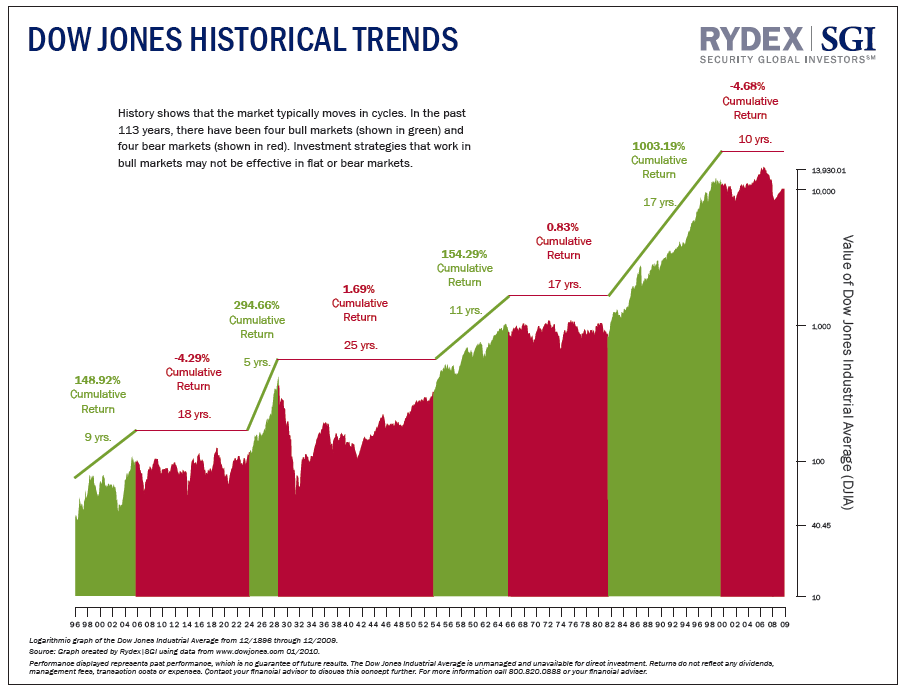
First, a “secular” market trend is a long-term trend. In this case, long term can be defined as anywhere between 5 and 25 years. While there will always be ups and downs, the primary trend will be in one direction or another.

A secular bear market is a long-term bear market with small bull markets every few years. A secular bull market is a long-term bull market with small bear market every few years.

Currently, many believe that a secular bull market in US equities ended in 2007, and a new, secular bear market has now taken hold.

Secular Bulls and Secular Bears

Click for a larger image

So what can you do?

Asset allocation allows you to deal with the ups and downs by having non stock holdings as well — Cash, Bonds, RE, and Commodities (GLD, OIL, etc,) that will offset stock weakness.

Simply put, tactical asset allocation is the method you use to buy and sell assets. This process includes what to buy and sell, as well as how much money to use at one time.

If your goal is diversification, then asset allocation is your plan. This means that diversification is the result or outcome of your decisions about buying and selling investments. For more background information, visit my page on tactical asset allocation at Invest-Safely.com.

Sources:
Tactical Asset Allocation During Secular Bears
The Big Picture
http://www.ritholtz.com/blog/2011/08/tactical-asset-allocation-during-secular-bear/

Tactical Asset Allocation
Invest-Safely.com
http://www.invest-safely.com/tactical-asset-allocation.html

Posted in Current Events, Historical Data, Market Trends, Other Blogs | Tagged , , , , | 2 Comments

Best Asset Classes – July 2011 Edition

Source:
July Recap… Fixed Income and Real Assets Roll
EconomPic
http://econompicdata.blogspot.com/2011/08/july-recap-fixed-income-and-real-assets.html

Posted in Current Events, Market Trends | Tagged , , | 2 Comments