
Stock Market Outlook entering the Week of March 10th = Uptrend
- ADX Directional Indicators: Uptrend
- Price & Volume Signals: Uptrend
- On Balance Volume Indicator: Uptrend
ANALYSIS
The stock market outlook shows an uptrend in place, with no change to the underling signals versus last week.
The S&P500 ($SPX) lost 0.1% last week. The index sits ~4% above the 50-day moving average, and 12.5% above the 200-day moving average (historically elevated).
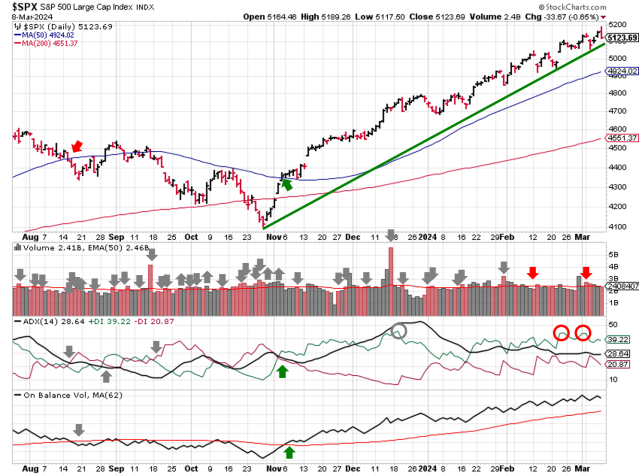
SPX Price & Volume Chart for the Week of Mar 10 2024
All three signals show an uptrend in place. The ADX continues to wane with the positive directional indicator elevated (yellow light). While outright distribution days have been in short supply since the beginning of the year, there have a been a couple of stalling days in the past 5 weeks, which were absent from last week’s chart.
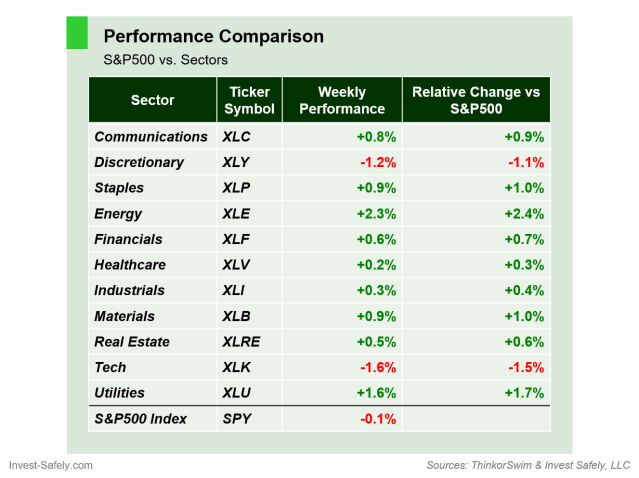
S&P Sector Performance for the Week of Mar 10 2024
While the S&P500 was basically flat for the week, the energy sector ($XLE) and utilities ($XLU) outperformed, taking their turn as beneficiaries of the decline in the yield curve.
COMMENTARY
While ISM Services PMI was in line with estimates, U.S. factory orders caused a brief stir in the equity market on Tuesday. New orders for manufactured goods in February fell 3.6% from January readings, which is the largest month/month drop since April 2020.
Wednesday’s JOLTS data was “unremarkable”, and Powell admitted to Congress what everyone in the banking industry expected: that pesky plan to raise capital requirements for large banks (i.e. Basil 3 standards) will be overhauled after industry complaints cost and economic impact.
Friday’s February nonfarm payrolls report showed 275k added jobs were added; more than the 198k forecast. Unemployment rose to 3.9%, while expectations were for it to remain at 3.7%. More importantly, though less reported, was the negative revision to January’s NFP data; jobs added was revised down from 353,000 to 229,000 (-35%)!
Speaking of things that didn’t get much notice, the Japanese Central Bank appears to be prepping the market for the end of its negative rate program, in place since 2016. Doing so would reduce the profitability of the Japanese Yen Carry Trade, a form of arbitrage used by institutions in forex/currency and debt markets. Employed across the globe since the mid-1990s, it came back into favor for the U.S. with the Fed’s recent hiking cycle.
Friday’s trading session also gave a great example of current market capitalization dynamics. The performance of the indexes looked “not good” for most of the day. But if you look beneath the surface, you’ll see that performance wasn’t widespread.
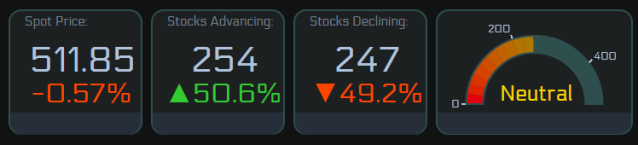
Source: T1 Alpha // https://tier1alpha.com/
The S&P500 ended the day with a 0.57% loss. But the number of advancing and declining stocks was 50/50. What caused the negative performance shift?
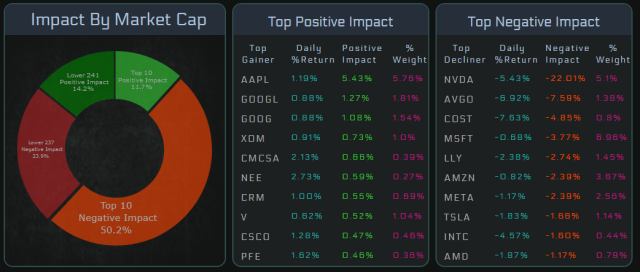
Source: T1 Alpha // https://tier1alpha.com/
As shown in the table above, 22% of the S&P500’s loss came from 1 stock, $NVDA. $AVGO and $MSFT didn’t help either. Per Goldman Sachs:
The 10 largest stocks now account for 33% of S&P 500 market cap, well above the 27% share reached at the peak of the tech bubble in 2000, and 25% of earnings.
The good news? High concentration doesn’t end rallies.
This week, we get CPI on Tuesday, PPI on Wednesday, and another massive options expiration (quarterly) on Friday.
Best to Your Week!
P.S. If you find this research helpful, please tell a friend.
If you don’t, tell an enemy.


 The Safe Investing Blog