
Stock Market Outlook entering the Week of August 6th = Uptrend
- ADX Directional Indicators: Uptrend
- Price & Volume Signals: Uptrend
- Elliott Wave Analysis: Mixed
ANALYSIS
The stock market outlook maintains an uptrend heading into August, but there are a few things to keep an eye on.
The S&P500 ($SPX) fell 2.3% last week. As of Friday’s close, the index sat ~1.5% above the 50-day and 9% above the 200 day moving averages.
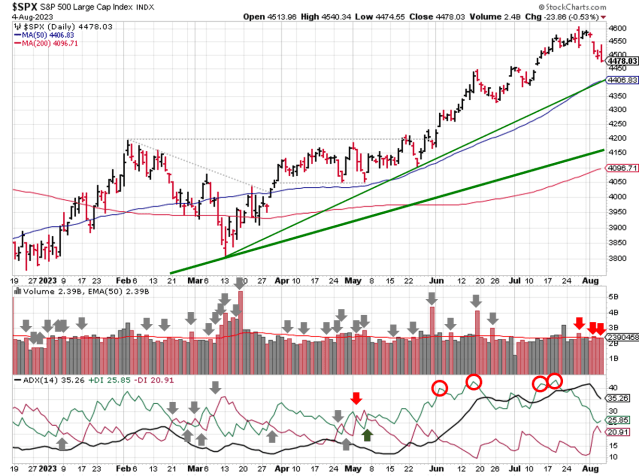
SPX Price & Volume Chart for the Week of Aug 06 2023
No change from the ADX last week, although the directional indicators did converge significantly during the sell-off.
Price/volume also remains in an uptrend, while picking up 3 distribution days in the past 7 sessions. Friday’s intraday reversal added a distribution day to the count, even though volume wasn’t extended from Thursday’s session.
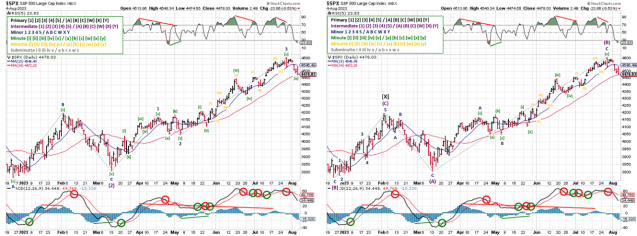
SPX Elliott Wave Analysis for the Week of Aug 06 2023
Elliott Wave remains mixed; both counts are working on their first wave down, after showing a completed rally on August 27 at 4607. Key support and resistance levels remain unchanged at 4169 and 4632.

SPX Elliott Wave Analysis for the Week of Aug 06 2023 – Bullish Count
Zooming out to the long-term view shows the rally extended for 5 weeks versus the last chart update in July.
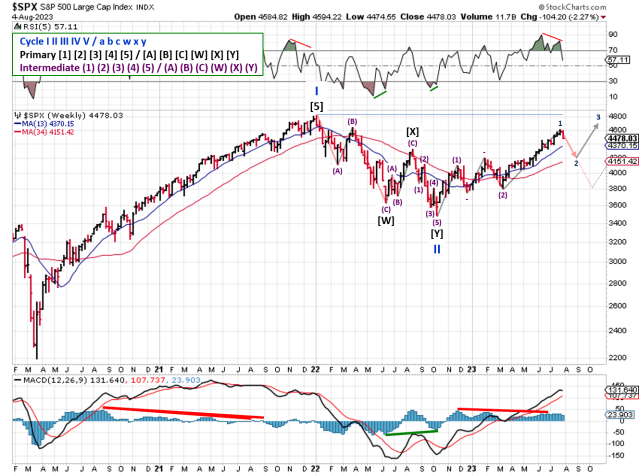
SPX Elliott Wave Analysis for the Week of Aug 06 2023 – Bullish Count
If the market truly started a new bull market last October, Elliott Wave puts the next in the S&P500 somewhere between 4200 and 3800; roughly a ~7% to 18% drop from Friday’s close.
If the S&P500 just experienced a long, bear-market rally from October 2022, then the next wave completes somewhere below the March 2023 low of ~3800.
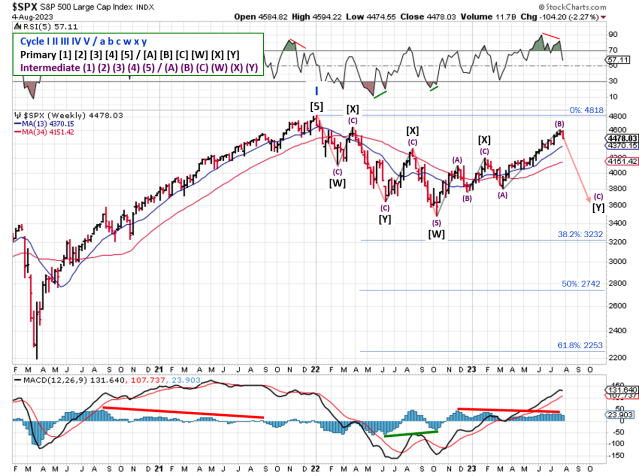
SPX Elliott Wave Analysis for the Week of Aug 06 2023 – Bearish Count
So for the next couple of months, Elliott Wave may not be much help in determining the longer-term trend.
COMMENTARY
On Tuesday, Fitch Ratings downgraded the Long-Term Foreign Currency IDR fpr the U.S. from AAA to AA+ (Fitch Downgrades the United States’ Long-Term Ratings to ‘AA+’ from ‘AAA’; Outlook Stable). IDR the abbreviation for Issuer Debt Rating. Per Fitch:
The rating downgrade of the United States reflects the expected fiscal deterioration over the next three years, a high and growing general government debt burden, and the erosion of governance…has manifested in repeated debt limit standoffs and last-minute resolutions.
Based on that rationale, I’m surprised anyone was surprised! In the end, the rating change means that this risk of owning U.S. debt is slightly higher now, so interest rates will rise to compensate.
The Non-Farm Payrolls report for June was a mixed bag. Payrolls were up 187K, missing the consensus estimate for 200K. Unemployment dropped 10 basis points (3.6% to 3.5%), and average hourly earnings increased more than expected (+4.4% Y/Y). These data points, combined with last week’s advanced GDP and PCE figures, are unlikely to dissuade the FOMC from raising rates again.
Best to Your Week!
P.S. If you find this research helpful, please tell a friend.
If you don’t, tell an enemy.


