
Stock Market Outlook entering the Week of July 16th = Uptrend
- ADX Directional Indicators: Uptrend
- Price & Volume Signals: Uptrend
- Elliott Wave Analysis: Mixed
ANALYSIS
The stock market outlook maintains an uptrend for the S&P500.
The S&P500 ($SPX) rose 2.4% last week. The index sits approximately 5% and 12% above the 50 and 200-day moving averages, respectively. Having eclipsed the August high point, the next level of resistance dates back to the high on March 29, 2022 at 4637.

SPX Price & Volume Chart for the Week of July 16 2023
No change in signal for the ADX. Price/volume also remains in an uptrend. No distribution days last week; Friday’s volume was above average, but the price movement didn’t qualify.
Elliott Wave is back under construction (i.e. mixed), with the SPX making reaching a “higher” high last week, and the MACD crossing over for the 4th time in the past 4 weeks.
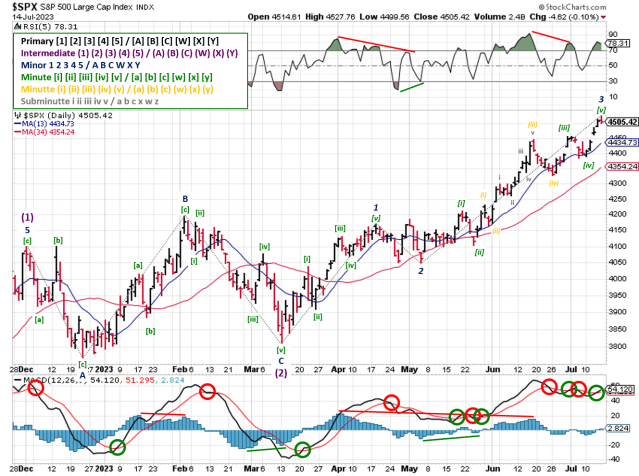
SPX Elliott Wave Analysis for the Week of July 16 2023 – Bullish
The bullish view required a rethinking of the Minor wave counts in order to accommodate the rally since mid-May. The next major resistance level is the 1.618 Fibonacci extension for Minor 3 (4632), with support near the Minor 1 high at 4169.
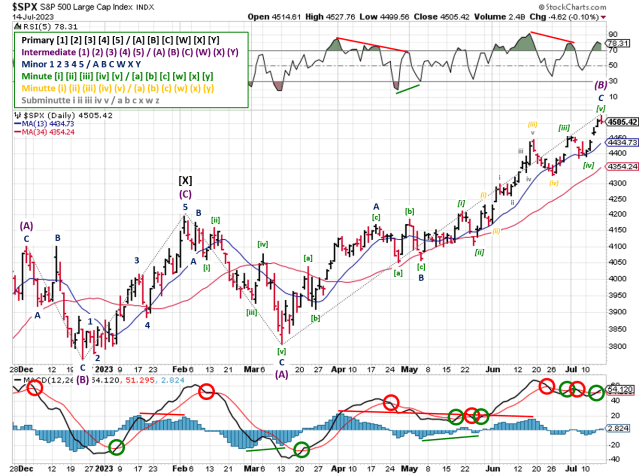
SPX Elliott Wave Analysis for the Week of July 16 2023 – Bearish
Meanwhile, incorporating the major inflection points from the bullish view allows the current bearish count to accommodate the latest move higher.
COMMENTARY
Government data continues to show inflation on the decline. Wednesday’s headline CPI figure came in at 3% year over year, which was lower than expected and a far cry from last June’s 9.1% reading. Core CPI remained elevated at 4.8%. The headline Producer price index showed a 0.1% gain verses last June, while core PPI rose 2.4% year over year.
Q2 earnings kicked off the same way that Q1 ended; headlines stating that earnings aren’t as bad as feared, as companies continue to beat analyst estimates. At the same time, earnings growth continues to decline.
You might be wondering how can earning growth can be negative if companies are “beating” estimates. There are 2 reasons:
- Analysts revise their estimates/targets lower making them “easier” to beat
- Companies and analysts use “adjusted earnings”, which remove certain expenses from GAAP figures.
Lowered expectations are easier to beat, especially after “adjustments” to expenses. These adjustments also make historical comparisons more difficult, since you have work with the companies financial statements to get an apples to apples comparison. Neither of those things makes for good headlines and/or 30 second soundbites.
According to Factset, earnings growth has been negative since mid-October of last year…the same time S&P500 bottomed. So the S&P500’s gains during the past 9 months weren’t driven by higher profits.
In terms of “valuation”or P/E ratio, the October reading for the S&P500 was 19-20 (Price to Equity using Trailing 12 months calculation). Last week, the reading was over 25. We know that earnings growth declined over the same period of time, so the “E” got smaller. So even if price or “P” didn’t change, the P/E ratio increases.
The above is a math-based way of that stocks are less valuable than they were in October, because stocks have increased in price per share AND are earning less per share. This is one of the very few instances when “inflation” isn’t considered a problem, because “stocks go up” is seen as a good thing.
This week, retail sales for June, as well as updated housing market data, are on the way. Monthly options expiration occurs on Friday.
Best to Your Week!
P.S. If you find this research helpful, please tell a friend.
If you don’t, tell an enemy.


